Friday, August 4, 2023

Video Game Review: Tears of the Kingdom

The sequel to Breath of the Wild was anticipated for quite some time. I remember finishing the game in 2020 (although it came out in 2017) and already was hearing the talk about the sequel. I believe it was first going to be called BOTW 2, but was later changed to Tears of the Kingdom. I wasted no time on this one and pre-ordered it so it would arrive as soon as it was on the market, on May 12. Aside from FIFA, this was the first game I've really immersed myself into in a while (especially in my new gaming zone in the basement). And unlike previous open world games, I decided to really take my time on the main quest and do as much side quests and exploring before finishing the game. 

I really enjoyed this game, which was basically a continuation of the format established in Breath of the Wild. The mainland map was the same, however there was a whole new addition of a sky world and an underground world to explore. I easily put over 100 hours in this game exploring, and still am only at about 46% uncovered. There's still so much to do, and I might play a little here and there, but for the most part am ready to move on. So as per usual I gotta make a thorough review to close out the gaming experience. I would most definitely put this game in my Top 25, but would still put BOTW ahead of it only because it was that game that established this incredible format. 

The Story

The story takes place several years after the events of Breath of the Wild. Princess Zelda and Link are exploring an underground cave, under the Hyrule castle, when they discover some ancient writings. They travel further and find a demon frozen, who awakens and kidnaps Princess Zelda. He uses all his power to withstand the demon, and is nearly killed, until the demon vanishes with Zelda. Link is later awakened in the sky islands, by the spirit of Rauru, an ancient Zona who was once the king of Hyrule. Rauru helps heal Link with a magical mechanical arm and informs him of the chaotic upheaval that has brought gloom and chasms to land of Hyrule. Link leaves the sky islands and begins his quest to find Zelda. 

Link begins his quest at the Hyrule Castle and eventually arrives to Lookout Landing where he gathers information from Purah and the Zonai Survey Team. As per usual Zelda format, Link must travel to the headquarters of the main species of Hyrule; the Zoras, the Gorons, the Geruda, and the Rito. What's nice however is the freedom to choose which region you want to explore first. Each of the civilizations have information on Zelda, but are stricken with their own issues brought on by the Upheaval. Link must help Price Sidon of the Zora, Tulin of the Rito, Yunobo of the Goron, and Riji the chief of the Gerudo. With each civilization he must journey into a temple to release the scourge of their land and uncover a magical stone. These stones are used by his new companions to unleash their magical powers. 

While Links recruits his new four companions, he also learns of the ancient history of the Zonai and how the Demon King came to be. He also discovers that Zelda has traveled back into this time to assist the Zonai. Ruled by King Rauru and Queen Sonia the Zonai were once a very technological civilization but were later deceived by Ganondorf. In an effort to stop Ganondorf, Rauru recruits heroes from each civilization to use their magical powers against him. However this is still not enough and Rauru must sacrifice himself to freeze Ganondorf. It is there Ganondorf stays until he is awakened by princess Zelda and Link, thus bringing about the Upheaval. Once Link acquires enough information he journey's to the castle where he discovers an imposter of Zelda, the phantom Gannon.

After defeating the Phantom Gannon Link must continue his quest to find more information on where the real Zelda might be. He learns of a fifth sage, known as Mineru, who was once a Zonai and the sister of Rauru. Mineru's physical embodiment comes in the shape of a cyborg who can fuse with various objects. Link also learns that Zelda swallowed her magical stone, to become an immortal dragon, protecting the Master Sword for Link to recover. Link then frees the Deku Tree from the gloom, and from there is able to locate Zelda, who is in the form of a dragon. 

With the master sword now in his possession, Link understands the only way to free Zelda is to defeat Ganondorf. He thus journey's with his five companions to the bottoms depths of the world to confront him. Link must first face an army of monsters, and then face Ganondorf, following by the phantom Gannon. In his last act of defeat Ganondorf swallows the magical stone to became a dragon. At this point Zelda comes to Link's aid where the two dragons must fight in the sky. Link is able to give the finishing blow to Gannon, by striking at the magical stone. With Gannon defeated, Hyrule is free from the gloom, and Zelda returns to her former self. 

The Game Play

The gameplay is just as enjoyable as it was in Breath of Wild, with some great new additional features. The first big one is an extension of the map with a sky world and an underground world. The sky world can mostly be accessed by watchtowers that launch Link high up in the air. From the sky islands Link can skydive or use the paraglider for a safe landing. The skydiving feature is perhaps my favorite new addition to this game, where it truly opens up the landscape. On the flipside of this is the underground that can be accessed thru chasms. This underground is also quite unique since it is covered in darkness, gloom, and all forms of monsters. Link must use various lighting tools to uncover light roots that help unveil the darkness. 

Another impressive new feature to this game is the new Purah Pad skills which encourage building. Link is able to use these magical skills thru his mechanical arm, which allows him to levitate objects, rewind time, ascend thru solid platforms, fuse weapons with miscellaneous objects, and auto-build machines and vehicles from previous designs. The ability to build is a very important feature in the game, especially solving puzzles such as in the Shrines. Link must often build bridges, ramps, or vehicles powered by fans, fire, or batteries. There are many tools and items Link can manipulate with his mechanical arm to build things. These items known as Zonai devices include; hot-air balloons, rockets, wheels, batteries, lights, flame-throwers, beam-shooters, water-hydrants, floating platforms, wing-gliders, mirrors, stakes, springboards, carts, and so forth. 

Just as in previous games Link can continue to improve his health and his stamina thru unlocking shrines. Stamina is very important for climbing, para-gliding, swimming, and running. The mobility in this game is just as liberating as it was before, however it does offer a realistic limit thru the stamina gauge. Link's combat style is the same as it was before with the additional abilities to flip, parry, and flurry-rush. These are especially important moves when fighting the more challenging bosses such as Ganondrof. However the true key element to Link's power is his weapon forging. This is essential to stand a better chance in combat. While swords are rare, sticks can be fused with Zonai blades to enhance their strength. Same goes for shields and arrows can be equipped with just about any item. Bomb-arrows are always the most effective tool in my opinion. 

Another different feature in combat, is Link's spiritual companions. Each of his companions has a special power that can be unleashed at Link's calling. The Rito Tulin can release a gush of air which is very helpful when paragliding; Yunobo can turn himself into a cannon which is very helpful for blasting thru rocks and stones; Sidon can provide a water shield as well as a blast of water (probably the least helpful of the group); and Riji can create an electrical forcefield that will cause significant damage when in enemy is struck by an arrow. Mineru's cyborg is also helpful as a vehicle when needed to climb over gloom. 

The game returns with it's vital survival feature, which was perhaps the biggest appeal of Breath of the Wild. Once again Link must acquire resources, hunt, scavenge, and cook meals to support his health. He can also cook elixirs by mixing bug parts with monster parts. The elixirs can give him many temporary boosts such as heat-cold-electrical resistance, glowing power, endurance power, slip-resistance, and just better general strength. Fire-making is a very helpful feature not only for cooking, but for passing time, or getting launched up in the sky. Sleeping is a great way to recover Link's full health. Link also has a collection of horses that can be tamed, named, and boarded in various stables. A bonus feature in this game (just as in BOTW) is to build a home for Link where he can collect his favorite weapons, board his favorite horse, cook his meals, and sleep at no charge.

Friday, July 21, 2023

Historical Study: The Rise of the German Empire

Studying world history never gets old and with each phase I can dive deeper and deeper into an era. For me reading and writing about history is a magical experience, like lighting a match in a dark library, that offers a brief glimpse into the world long ago. This time it's yet another return to German history. I've been in numerous German phases now and wrote several posts back in 2012 (see German Culture and Study of German History). Ever since their role in WWI and WWII, the word "Germany" is quickly associated with military aggression and wickedness. However putting those events aside they still have a very rich history at the center of European politics, particularly at the turn of the 19th century. 

It's thru my continuous studies of the outbreak of WWI, that I now turn my attention from the Balkans to the Germans. It is a common understanding that Germany was the key instigator in WWI, with most to gain from the conflict. At that time they had become one of the main 5 powers in Europe alongside France, Britain, Russia, and Austro-Hungary. But what was the evolution of this powerful rise? How did the German Empire come to be? 

This central region of Europe has long been referred to as "Germania" but never was there a "German" kingdom to rival Britain or France during the middle ages. Instead there was the Holy Roman Empire and the Kingdom of Prussia that oversaw this region of Germania. It was not until the 1800s that this new nationalist ideal of Germany was established. Although the German Empire was rather short-lived (approx 50 years) it briefly became a world superpower. So here I'd like to focus on the events leading to the establishment of the German Empire to it's eventually demise after WWI.    

The German Confederation

Throughout the middle ages from 962-1806 most of mainland Germania (and central Europe) was ruled by the Holy Roman Empire. By the 1600-1700s this territory became mostly disputed between the Austrian and Prussia kingdoms. In1806 Napoleon defeated the Austrians at the Battle of Austerlitz which brought on the complete dissolution of the Holy Roman Empire. At this point the land in Germania was broken up into smaller states that answered to France (known as the Confederations of the Rhine). This was only for a brief period up until the defeat of Napoleon in 1815. The boundaries of Europe were once again redistributed in the Treaty of Vienna. The German Confederation was thus established as the new defined territory of allied states, which included the Kingdom of Hannover, Saxony, Bavaria, and even the Austrian Empire. However it was the Kingdom of Prussia that oversaw this region and became the new power of central Europe. 

During this period Germany was made up of 39 sovereign states similar to the United States, however without a federal leader, like a president. The Federal Convention was it's main governing body of representatives based in Frankfurt. However this system was not always fair or balanced due to the superior and conflicting interests of Austria and Prussia. Both these kingdoms dominated the Confederation's political affairs. By the 1840s a new wave of nationalism swept across Europe, that witnessed a wave of political revolutions. From 1848-1849 German revolutionaries consisting of liberal and working class principles, pushed for the establishment of a new united German Empire. The revolution was eventually put down by 1850.

Following the revolutions, it was during the 1860s that Prussia began it's political moves to eventually establish the German Empire. King Wilhelm instituted a new increase in military production and appointed Otto von Bismarck as the new chancellor of his kingdom. It was Bismarck who oversaw key victories against the Danish and Austrian kingdoms. The Austro-Prussian War of 1866, lasted only for seven weeks and marked a new transfer of power in the German Confederation. The Prussian Kingdom dissolved the German Confederation into a new alliance known as the North German Confederation. Austria was removed from the alliance while parts of their land were acquired by Prussia. In 1870 France declared war on Germany to assert its dominance however was defeated and forced to give up land to Germany. A year later in 1871 Otto von Bismarck restructured the Confederation (including Prussia) into one centralized German Empire. 

Otto von Bismarck establishes the German Empire

The city of Berlin became the capitol of the newly established German Empire, with King Wilhelm as the de facto ruler and Bismarck as the proper head of government. The main reason for Germany's sudden rise to power was their booming industry. During the Industrial Revolution, Germany became one of the leading iron and steel producers in the world. They paved the way for new innovations and higher efficiency in industry, technology, science, physics, and chemistry. Thru their means of mass production and high efficiency, Germany quickly arose to become one of the largest economies in the world rivaling Britain and the United States. They also continued to expand it's military thru longer railways, a larger navy, and heavy production of weaponry. The German Manufacturer company Krupp became the largest distributor of military arms in the world. 

While the German Empire had a king, this was mostly symbolic, and the government was more of a constitutional monarchy, similar to Britain. Otto van Bismarck was the head of the government, referred to as the chancellor, and there was an elected body of parliament known as the Reichstag. Although it was now a federal government, there was still significant influence from the state of Prussia. The government was mostly authoritarian and preserved most power to noble and aristocratic family dynasties. However over time this slowly became more democratic as the general population were allowed to vote for their elected officials. 

The other powers in Europe quickly became threatened by the rising Germany, especially France. Having just been defeated in the Franco-Prussian War, France decided to establish an alliance with the Russian Empire in 1893 so as to pin Germany. In response to this move, Germany established an alliance with Austro-Hungary and strengthened it's ties with Russia. It developed an incredible railway system connecting much of Europe and reaching as far into the Ottoman Empire. By the late 1890s German steel production had surpassed Britain, who also had started to feel threatened by the rising superpower. In 1907 the Triple Entente alliance was established between France, Russia, and Britain so as to counter the rising strength of Germany.   

Bismarck's main incentive as chancellor was to win over and unite the general public from all states and wealth classes to accept Germany as their national land, a process known as Germanisation. For this he is often regarded as the true founder and hero of Germany's history. Some of the policies included eliminating foreign languages that weren't German and restructuring the education. Poles were affected most by these social changes, being forced to eliminate their customs and were seen as the ethnic minority. Bismarck also reformed the influence of the Catholic church, by limiting their power and control over education and political affairs. Also during this boom of German nationalism came an increase in antisemitism and racism against those that were different from the unified German community. This fervor would especially pick up after WWI, that led to the radical establishment of the Nazi Party. 

Kaiser Wilhelm II takes power

In 1888 King Wilhelm died and his son Frederick III became king, only for 99 days until he died. The throne then passed over to the next in line, Wilhelm II, the son of Frederick III. Right from the onset Wilhelm II wanted to take control of his empire (unlike most other constitutional monarchies) he wanted to lead rather then be a de factor leader. He thus saw Otto von Bismarck as his utmost rival, and the two came to frequent clashes early in his reign. Finally in 1890, the much older Bismarck decided to resign leaving Wilhelm II with total ruling power over the empire. This brought an end to the Russian-German non-aggression agreement, which would later become a terrible mistake. 

Unlike his grandfather, Wilhelm II wanted to be involved in all administrative and political affairs.  
Some of the Kaiser's most notable actions included strengthening relations with the Catholic church while squashing the rise of Socialism and Marxism. He also strengthened ties with the faltering Ottoman Empire by building the Baghdad railway to better connect Europe with Asia. Wilhelm II also pushed for the expansion of a colonial empire, similar to Britain or the United States, and established colonies in Africa. This eventually led to a dispute over Morocco between France and Germany in 1906, which made relations all the worse. Soon it had become clear that Germany had more enemies then allies. 

By the early 1900s Germany must have begun to feel the pressure building around it with the establishment of the Triple Entente. Furthermore it's only main ally Austro-Hungary was falling into hot water over Balkan disputes. Austro-Hungary quickly found itself in fierce opposition to the Russian Empire when it annexed Bosnia and Herzegovina in 1908. This territory was disputed by Serbia who had the full support of Russia and only added to the Balkan hostilities. By this point it seemed eminent that a military conflict would begin with Austro-Hungary verses Russia, and Germany would be dragged in no matter what for it's alliance but more so the balance-of-power. 

All of Europe had become a game of chess between the main powers using their proxy states to show their intentions. Under Wilhelm II's leadership it appeared Germany had lost much of the diplomatic balance that Bismarck had established (especially with Russia and Britain). Now Germany found itself very isolated carrying three weaker allies in Austro-Hungary, Italy, and the Ottoman Empire. Bulgaria also later joined with these central powers in hopes to reclaim lost land in the Balkans. With these alliances established all that remained was a spark, and that came with the assassination of Franz Ferdinand in 1914. After this event, Germany publicly supported Austro-Hungary's invasion of Serbia, which in some regards was the start of WWI. This led to the domino effect of the power balance, and what should have been a regional dispute blew up into a global dispute. Germany knew it's time to act had to come now or never if they were to survive the alliance of Britain, France, and Russia.

The war began favorable for the Germans who knew their greatest threat would be in France. They quickly moved thru Belgium and Luxembourg to establish their defensive lines. It was in eastern France that the infamous trenches were established due to the unforgiving weapons of both sides. The French were eventually able to push the invading Germans back, and thus Paris was never captured. In 1917 the Germans got a lucky break when the Russian Empire collapsed to the Bolshevik Uprising. They were able to acquire new land in the east and could now focus it's full attention on the western front. However even despite this event, it was too little too late, to oppose the combined allied forces of France, Britain, and the United States. Germany was forced to surrender in 1918 and the Treaty of Versailles harshly blamed them for starting the war. 

The German Revolution and Weimar Republic

Wilhelm II remained king after the war however he was very unpopular amongst the low morale of the German people. Their economy was harshly devastated by war reparations as well as a new influx of the Spanish flu epidemic. Towards the end of WWI a new political uprising was born in Germany that had spread from the Bolshevik uprising in Russia. With the transition of power in disarray in November of 1918 imperial soldiers disobeyed their orders and civil unrest spread throughout the nation. Shortly after Wilhelm II was forced to flee Germany and abdicate his throne. This marked the end of the German Empire and the dawn of the Weimar Republic. Wilhelm fled to Netherlands where he spent the rest of his days. 

There was a brief period of calm in Germany for about a month until a second uprising occurred in January of 1919. This was initiated by a socialist/Marxist movement led by Rosa Luxembourg and Karl Liebknecht. Civil unrest once again took the streets of Berlin headed by the Spartacist communist league. The uprising was however quite disorganized and quickly squashed by the German militia. Furthermore their leaders Luxembourg and Liebknecht were discovered and executed on the spot. By the end of 1919 the civil unrest had been pacified however the nation remained in disarray. Aside from it's economic debts there were still underground political extremists at work on both the right and the left. The Weimar Republic remained shrouded by a cloud for most it's tenure by a majority of bitter Germans. At the onset of the Great depression in the 1930s gave way to the rise of a new extreme government, known as the Third Reich, that sought to reestablish the glory and might of the once German Empire.        

Sunday, July 16, 2023

Historical Study of the Balkans

A couple weeks ago I visited Kansas City with my parents and despite the very hot weather we had a good time right downtown. My dad and I visited their WWI museum, which happens to be the biggest WWI museum in the country. I walked out of that place quite inspired seeing the artifacts, uniforms, and weapons that were actually on the battlefield. So naturally I decided to start yet another WWI appreciation phase and got a book on the topic. This time however I was most intrigued by the start of WWI and have thus started reading, The Sleepwalkers by Christopher Clark. The book gives a very detailed start of the diplomatic and political events leading up to 1914.

The cause of WWI was one of the more complex historical events of this modern era. At the turn of the century Europe was booming with industrial advancements and thus began a power shift. A new system of alliances was created to support one another in the case of a conflict. The German Empire was at the heart of this power struggle and had made strong allies with the Austro-Hungarian Empire and Ottoman Empire (known as the Central Powers). On the other side were the Triple Entente which consisted of Great Britain, France, and Russia. All that was really needed was a spark to ignite the conflict and this did not occur within the homeland of the main powers. Instead it occurred in the southeastern region of Europe known as the Balkans. 

The nations that make up the Balkans consist of Serbia, Bosnia and Herzegovina, Albania, Bulgaria, North Macedonia, Montenegro, Croatia, and Kosovo (sometimes Greece, Slovenia, Romania, and Turkey are included in this group). At the center of the region are the Balkan Mountains, hence the name. I know very little about these nations, aside from tennis great Novak Djokovic and Croatia's talented soccer team. The region was once at the center of it all during the Greek and Macedonian Empires, however has later taken a back seat to modern history. Perhaps its greatest claim to fame in the last 100 years was giving birth to WWI. However it still has a unique and diversified population which I would like to better understand thru it's history. 

Greco-Persian Wars

The Balkan tribes and territory was first conquered by King Darius the Great in 513 BC. During his Scythian Campaign he pushed his forces from Turkey, northward, along the Black Sea capturing territory on the eastern coast of the Balkans and southern regions of Ukraine and Russia. In order to defend their lands the local Scythians (who were Iranian immigrants) used scored earth tactics so the Persians would not have resources. Darius decided not to push too far inland into Europe, and built defensive lines throughout his captured territory near the Black Sea.

The Persian Empire continued it's conquest of the Balkans throughout the 6th and 5th century and began capturing territory in Macedonia., Greece, and Thrace (modern day Bulgaria). By 499 BC the Ionian Revolt in northern Turkey against Persian occupancy gave way to the Greco-Persian Wars. The Greek states had organized a powerful coalition to aid the revolts and resist the Persian conquest. This conflict went on for nearly 50 years mostly fought in Greece, Bulgaria, and northern Turkey. In 492 Darius invaded Greece and was able to capture Thrace and Macedonia, however not it's capitol of Athens. Several years later Darius' son Xerxes continued his father's conquest by invading Greece a 2nd time in 480 BC. This time however both Sparta and Athens were able to defeat the Persians, most notably at the Battle of Thermopylae. 

The Macedonian Empire

The Greco-Persian Wars weakened both the Persian and Greek Empire and gave way to a new rising power in the Balkans, the Macedonians. However before the Macedonians could secure control of the region they had to defeat the formidable Illyrians. The Illyrians were based in the western regions of Albania and Montenegro founded by their war chief, Bardylis. In 359 BC the Illyrians killed the Macedonian king Perdiccas III, which brought on the wrath of his brother Philip II. Within a year Philip had reclaimed land from the Illyrians and also strengthened ties with the Greeks. During his reign Macedonia became the new central power in the Balkans. 

This of course gave way for his son Alexander the Great, who would become the greatest conqueror in world history. Before Alexander began his eastward push thru Persia and into India he was able to crush the Illyrian forces by 335 BC. The conquests of Alexander brought upon a new fusion of European, Middle-eastern, and Asian culture that later became known as the Hellenistic age. After Alexander's death in 323 BC, the mighty Macedonian Empire crumbled into smaller parts. Greek states and the Illyrians once again returned to control the Balkans. However they were all later crushed by the new coming power from Italy, the Romans. 

The Roman Empire

From 229-219 BC the Romans and Illyrians battled one another in the Illyrian Wars for control of the Balkan region. The last king of Illyria and Macedonia were both defeated in 168 BC which brought on a new era of Roman control. The Balkan region was broken up into Roman Provinces; Macedonia, Epirus, and Achae were based in the southern region of modern day Greece. Thracia was the province to the east, where it's capital city of Byzantium was formed. Here was the gateway of Europe and Asia where modern day Bulgaria and  Turkey met. At it's core was the central region of Moesia, present day Serbia. To the north was the region of Dalcia which made up present day Romania and northern Serbia. To it's west were the regions of Illyricum, Pannonia, and Dalmatia where the Illyrians once ruled. It was the mightiest of the regions that would later become modern day Bosnia, Albania, and Montenegro. 

While the Roman Empire was centralized in Italy most of it's mainland was in the Balkans and remained so until it's collapse in 500 AD. It was perhaps the final remaining territory of the Roman Empire that became host to new barbaric invaders such as the Goths and the Huns. The Roman Empire eventually collapsed in western Europe however was able to restructure itself into a new empire in the eastern Balkan region. This was centralized in the city of Byzantium, which later became renamed Constantinople as the capitol city of the Byzantine Empire.

The Byzantine Empire

The period after the Roman Empire is often referred to as the Dark Ages across Europe where there really wasn't an advancing civilization. Most of Europe consisted of Barbaric tribes and warlords vying for territory. However the new spread of Christianity became the light, and the Roman emperor Constantine established the city of Constantinople as a new religious capitol. Once again the Balkan territory made up the mainland of the Byzantine Empire, with it's central activity happening in northern Turkey. The empire flourished during the Macedonian Renaissance of 867-1065 AD. Some of the most iconic art and architecture was created during this age, that introduced a new style of mosaics. 

However the region of the Balkans once again became battlegrounds between the east and the west, during the Crusades. The Empire suffered it's first devastating loss at Constantinople in 1071 to the Seljuk Turks. They were sacked once again in 1204 by the western Latin Christian army. The Empire briefly recovered in 1267 under the Palaiologos dynasty and withstood continuous assaults from the Turkish Muslims. However they soon began to experience internal conflict with the rise of the Bulgarian Empire and the Serbian Empire. Little by little the empire shrunk in seize due to these internal civil conflicts, the spread of the Black Death, and Muslim raids on it's eastern front. Eventually Constantinople would fall to the Ottoman Empire in 1453.

Slav Migration, Bulgarian Empire, Serbian Empire

The region of the Balkans is made up of various ethnic groups that have inhabited the area throughout history. This primarily breaks down into the Greek/Roman ethnicities along the Adriatic Sea; The Arab/Turkish people along the Black Sea; and the Slavs that migrated from northern Europe and Russia. This massive migration began in the early middle ages from the 6th to the 7th century, after the fall of the Roman Empire. Similar to the Vikings (but maybe not as violent), these Slavic tribes were seeking warmer climates. They scattered all across Europe, the ones who settled in the Balkans were referred to as the South Slavs. They mostly inhabited the regions of Serbia, Bosnia, Croatia, and Montenegro. Today they are the predominant ethnicity in the Balkan territory. 

The first major Balkan civilization to arise was the Bulgarian Empire in 681 AD. The region was made up of Slavs and Turks, established by Khan Asparuh who defeated the Byzantine Empire. The Bulgarian Empire remained the dominant force in the mainland Balkans for nearly 400 years. They converted to Christianity by the 800s and resisted many attacks from the Byzantine Empire, Hungarians, and Turkish. Their greatest leader was Simeon I of Bulgaria, who ruled from 893 to 927 and led the empire to it's greatest expansion with victories over the Byzantines and neighboring warlord tribes. This was the golden age of the Bulgarian Empire, however it's conflicts with Byzantine continued for many years after. The Bulgarian Empire was eventually swallowed up by the Ottoman Empire in 1396.

Another Balkan civilization to break away from the Byzantine Empire, was the Serbian Empire in 1346. This was brought about thanks to a Civil War in the region from 1341-1347. Stefan Dusan the Mighty became the first king of the Serbian Empire and established a new power in the Balkans. Dusan promoted the Christian church as well as a new legal system that became known as the Dusan's Code. He was able to conquer land in Macedonia, Albania, and Greece and stretched his empire as far south as the Gulf of Corinth. He however fell short of conquering land from the Bosnians. In 1355 Stefan died, and shortly after the Serbian Empire was weakened. In 1389 the Serbians wer defeated at the Battle of Kosovo by the new superpower from the east, the Ottoman Empire. It was not much long after that Constantinople would fall, and the Ottomans would possess the entire Balkan region. 

The Ottoman Empire

Centralized in the capitol city of Constantinople the Ottoman Empire became a diverse civilization of Turk Arabs and European Slavs. In the late 1480s this empire consisted mostly of Turkey and the Balkan territory. However by the 1680s it expanded it's territory up into Hungary and Ukraine and along the northern coast of Africa. Constantinople became the capitol of the world and the Balkan territory was once again at the heart of a mighty empire. The Ottoman monarchy was however very tolerant of different religions and cultures and welcomed the continued practice of Christianity in the Balkan region. 

During this time, the Balkans were made up of provinces that answered to the Ottoman Empire however were also granted liberties to govern themselves. One of the notable new sovereignties to arise during this time was the Republic of Ragusa, based in Dubrovnik, Croatia. The Ottoman Empire aided Ragusa in it's conflicts with the Republic of Venice. During this time many Turks migrated into the Balkan territory settling in Bulgaria, Serbia, Macedonia, and Greece. For the most part the Balkans managed themselves quite freely, aside from some taxes to be paid the Ottoman Empire. However by the early 1800s, a new wave of nationalism arose in the region. Perhaps inspired by the American and French Revolutions. 

Balkan Independence Movements

This notion of a national awakening spread all throughout the Ottoman Empire during the early 1800s. This growing ideological storm supported by Europe would slowly tear away at the Ottoman's administrative millet system. Perhaps the most rebellious state in the Balkans during this time was the Serbians, who eventually gave way to an uprising in 1804. This revolution went thru two major phases, led by different leaders, with hopes to break away from the Ottomans and re-establish their Serbian Empire. The 1st uprising was led by Dorde Petrovic (better known as Karadorde) yet was squashed in 1814. The Second Serbian Uprising was led by Milos Obrenovic and this time they achieved their liberty and established their own Principality of Serbia in 1817. 

The Serbian Revolution caught on like a wildfire throughout the Balkans, and soon after the Greeks also achieved their independence in 1829 (after a ten year struggle). The Bosnians also initiated a major uprising in 1831-1832 and in 1875 however both were suppressed. These cries for nationalist awakening were eventually heard by the new emerging Russian Empire in the east. The Russo-Turk Wars of 1877-1878 opened the doors for Balkan independence. Much of the Balkan states allied with Russia to fight the Ottomans in this decisive battle located in the Caucasus Region. Thru this conflict Bulgaria, Romania, and Montenegro were able to break free and establish their own principalities. 

After Russia's victory over the Ottoman Empire, Germany came in as a neutral to discuss the treaty terms. The Congress of Berlin in 1878, headed by German Chancellor Otto Van Bismark, is seen as a turning point in Balkan history, where new sovereignties were officially recognized. This established new territory lines within the Balkans in which Serbia, Bulgaria, Romania, Greece, Montenegro, and Bosnia now all had their own states. The Ottoman Empire was left with some territory in Albania and Macedonia however this no doubt marked their decline and eventual collapse. Despite this successful treaty, the stabilization was rather short lived and territorial disputes arose amongst the newly established Balkan states. This was even further ignited by the interests of the major world powers of Germany, France, Britain, Russia, and Austro-Hungary. 

The Bosnian Crisis and the Balkan Wars 

Following the Congress of Berlin, there was still much animosity over the distribution of territory within the Balkans. The Russian Empire felt they were robbed of territory, having been the ones who defeated the Ottoman Empire. Germany and Austria-Hungary seized much of the land particularly in Bosnia. Bosnia became the black sheep of the Balkan region, with it's allegiance to the Austro-Hungarian empire in the north. Many Serbs and Slavs felt this territory should be united with Serbia and thus the tension spread during the early 1900s. It especially began in 1903 with a coup d'état in Serbia where King Alexander Obrenovic was assassinated. A new dynasty came to power in Serbia, with strong ties to Russia and severe hostility towards Austria-Hungary. This tension grew even hotter when Austria-Hungary annexed Bosnia in 1908. This not only infuriated Seria, but also Russia and Italy. 

As the tension boiled with Bosnia, Serbia and Bulgaria became the key leaders of the Balkan region. In 1912 they supported Albania and Macedonia's push for independence. A Balkan League was thus created and waged war once again against the Ottoman Empire to drive them out completely of the Balkan region. Following this conflict however, Bulgaria was still dissatisfied with the land distribution and turned on it's Balkan allies in the Second Balkan War of 1913. However Bulgaria was defeated by Serbia who had emerged as the new leader of the group with intentions to unify the Balkans into one Slavic state known as Yugoslav (supported by the Russians). Meanwhile frustrated with their defeat Bulgaria established a new alliance with Germany and Austro-Hungary. 

The July Crisis of 1914 and WWI

The Yugoslav nationalist movement had grown quite radical throughout Serbia, and even had conspirators within Bosnia. They had established a secret military society known as the Black Hand with intentions to unify all South Slavs. It was the Black Hand that organized the assassination of Franz Ferdinand in Sarajevo, heir to the Austria-Hungary throne in July of 1914. Although Serbia claimed to be unaware of this assassination plot, they were still blamed for their political hostilities towards Austria-Hungary. The aftermath of this assassination was a domino effect of tactical alliances leading towards war known as the July Crisis.

What should have been a straight forward dispute between Serbia and Austria-Hungary snowballed into a much wider conflict pertaining to the global powers. Austria-Hungary would have easily crushed Serbia, however Serbia had strong support from the mighty Russia. Henceforth Austria called upon Germany to support them in their call for war against Serbia and Russia. France was bound to Russia in an alliance and the two nations believed that Germany had orchestrated the whole affair as a power grab in Europe. Britain was the last of the main powers to chose a side, and while they had good relations with Germany, they decided they had an obligation to defend Belgium and support their allies in France. So by late July of 1914 all of Europe was engulfed in the most atrocious and deadliest war in history. 

While Germany invaded Belgium and France, Austro-Hungary invaded Serbia. Surprisingly the Serb Army was able to repel the first invasion and were victorious at the Battle of Cer in August of 1914, often considered as one of the biggest upsets in modern military history. The following year however the Germans launched a second invasion of Serbia, and this time the Serbians were forced to retreat into Greece. By 1915 Bulgaria decided to join the side of the Central Powers, having loss the Balkan Wars to Serbia a year earlier. They were able to make some advances into Romania and Macedonia, however their success was short-lived due to a poor economy and growing anti-war communist sentiments. The Balkans were occupied by the Austro-Hungarians for most of the war, until the Allied Vardo Offensive in 1918. The French, Serbian, and Greek forces were able to drive the Germans and Bulgarians out of Macedonia. This was a decisive victory in the Balkan theatre and by this point Austro-Hungary and Germany were defeated in the western theatre by Britain, Germany, and the United States. 

Establishment of Yugoslavia

The aftermath of WWI was felt all throughout Europe and completed changed the balance of power. The Ottoman Empire and the Austro-Hungarian Empire were disbanded, the Russian Empire was dissolved from within by a Communist revolution, meanwhile the Balkan territory was completely restructured. Despite their economic peril Serbia had achieved it's pre-war ambitions when a new nation of Yugoslavia was established. This included the regions of Serbia, Bosnia, Croatia, Slovenia, and Montenegro into one nation. Greece, Albania, and Bulgaria became their own independent nations. Much ethnic cleansing went on during this period so that inner conflicts would subside, and many Turks were expelled from the Balkans. 

King Alexander established a new Yugoslav dictatorship in 1929 with the goal to implement a nationalized and unified Yugoslav ideology. In 1934 however King Alexander was assassinated by a Macedonian Revolutionary outfit, and the state went thru a period known as it's regency. At the outbreak of WWII, Yugoslavia was too weak to offer any counter to the rising threat of Nazi Germany, and signed a cooperation deal with the Axis Powers. Despite this arrangement, the Nazis still invaded Yugoslavia in April of 1941 and easily conquered it. Meanwhile Albania and later Greece were  conquered by Nazi's allies in Italy. Bulgaria once again sided with Germany hoping to strengthen their position in the Balkans. The Nazis occupied most of the Balkans until the end of the war. 

After WWII, Yugoslavia regained it's liberation however this time it was now under the heavy influence of the Soviet Union. Communist Russia now had influence over Bulgaria, Yugoslavia, and Albania however this was short-lived. In 1948 Yugoslavia's president Josip Broz Tito broke away from the Soviet Union to manage their own independent socialist nation. During WWII Tito was a leader of the Yugoslav Partisans and considered a hero to their people. He lead the nation thru many global political reforms and established the non-alignment movement (nations that did not support the Eastern Communist Bloc nor the Western NATO Bloc). Although he was a dictator he oversaw a peaceful era in the Balkan region that continued to unify the ethnicities. 

The Yugoslav Wars

Following the death of Josip Tito in 1980, the presidency was alternated among different ethnicities within Yugoslavia so as to keep the peace. However the tension returned in 1990 after the fall of the Soviet Union. Much of this tension arose from the province of Kosovo who had begun to demand it's own state. The ethnic tensions boiled over into separate independence movements that eventually led to the fall of Yugoslavia. From 1991-1995 were a series of armed revolutionary conflicts against Serbia and Montenegro who intended to withhold the state of Yugoslavia. First it began with Slovenia, then Croatia, then Bosnia, Kosovo, Albania, and Macedonia all achieving their independence. 

By 2001 the Yugoslav Wars had come to an end and the Balkans were divided up into various independent sovereignties. The wars caused much economic damage and racial animosity due to many cases of war crimes and even genocides. To this day there is still some tension in the Balkan region particularly in Kosovo who has still not been officially recognized as it's own independent state. Most of the Balkan states eventually joined with the NATO Bloc, except for Bosnia and Serbia who still support Tito's neutrality alignment. While the Balkan territory is not quite at the center of current global affairs, it still has a very rich history. 

Monday, June 12, 2023

Historical Study: World Colombian Exposition

I recently started reading the book Devil in the White City by Erik Larson and intended to have a book review. However the book is really more of a historical account of the world fair rather then a fictional story. It gives a very detailed account of the planning and preparation that went into the 1893 World Colombian Exposition that took place in Chicago. The planning is mostly from the perspective of the famed architect Daniel Burnham. However it also provides a simultaneous account from the infamous serial killer of the time, H.H. Holmes. With these two accounts going back in forth in a historical timeline, the book provides an incredible insight into Chicago during the 1890s. In this post I don't want to focus on the serial killings, but more so the fair itself in further detail. 

I love everything about Chicago, was born there, and lived there for a year in 2008. However I only recently learned about the Chicago World Fair of 1893, regarded as one the biggest world fairs in history. I wrote about it here in my study of World Fairs, and learned that it is regarded as one of the most famous alongside the Paris Exposition of 1889. This massive event essentially put Chicago on the global map as an American super-city, 2nd only to New York City. Hosted in the south part of the city at Jackson Park for 6 months it attracted over 27 million visitors from all over the world. The event must have been a magical experience far greater then that of a theme park. The architecture was grand scale, the attractions were unending amusements, and electricity was making it's major debut. It was truly a city within a city, one that we can only now imagine thru photos and writings. 

The Construction and Preparation

During the 1880s-1890s the world was experiencing an industrial boom, often referred to as the Gilded Age or the Belle Epoque. World expositions to demonstrate these industrial achievements first became popular in Europe during the 1850s. London hosted the first major one in 1851, followed by several events hosted by Paris. It was in 1889 when Paris shocked the world with it's mammoth Exposition Universelle that debuted the Eiffel Tower as the world's new tallest structure. America saw this as a statement and quickly began planning an event to surpass the scale of the Paris 1889 fair. It was agreed that they would host the fair in 1892 to commemorate the 400 year anniversary of Christopher Columbus discovering America (although the fair did not occur until a year after this).  

America was leading the way during the Gilded Age with industrial innovations that far exceeded the rest of the world. They had already hosted numerous exposition fairs such as in New York (1853), Philadelphia (1876), Louisville (1884) yet none of these matched the scale of the Paris events. Congress began to deliberate over who would host the massive event, either New York City, Chicago, St. Louis, or Washington DC. Major financial titans such as JP Morgan Chase and Vanderbilt offered to fund New York while Chicago investors such as Marshall Field pushed for the event to be there. The decision was finally made not so much due to the financial investments but because of the midwestern location of Chicago. Unlike the compact location of New York City, there was space to build which would make it easier for both the construction and visitors alike. 

The commission of the Chicago Fair chose Daniel Burnham as chief architect of the project. He was a well established architect who alongside his partner John Root, had become the most prominent architecture firm in the city. Aside from building many mansions for Chicago's wealthy elite, particularly those associated to the Union Stock Yards, the Burnam and Root firm also built notable skyscrapers in Chicago including the Rookery Building and the Masonic Temple (which was the tallest building in Chicago from 1895 to 1920). This of course was a special project however and required many other architects to work alongside Burnam such as the famed landscape architect Frederick Olmsted. The design was to be one of a neo-classical city with elaborate and colorful landscaping, yet also one that could be easily brought down. Since it was to be a temporary event, most of the buildings were constructed in wood, covered in plaster, and painted white (Hence it's nickname the White City).

The Architecture of the White City

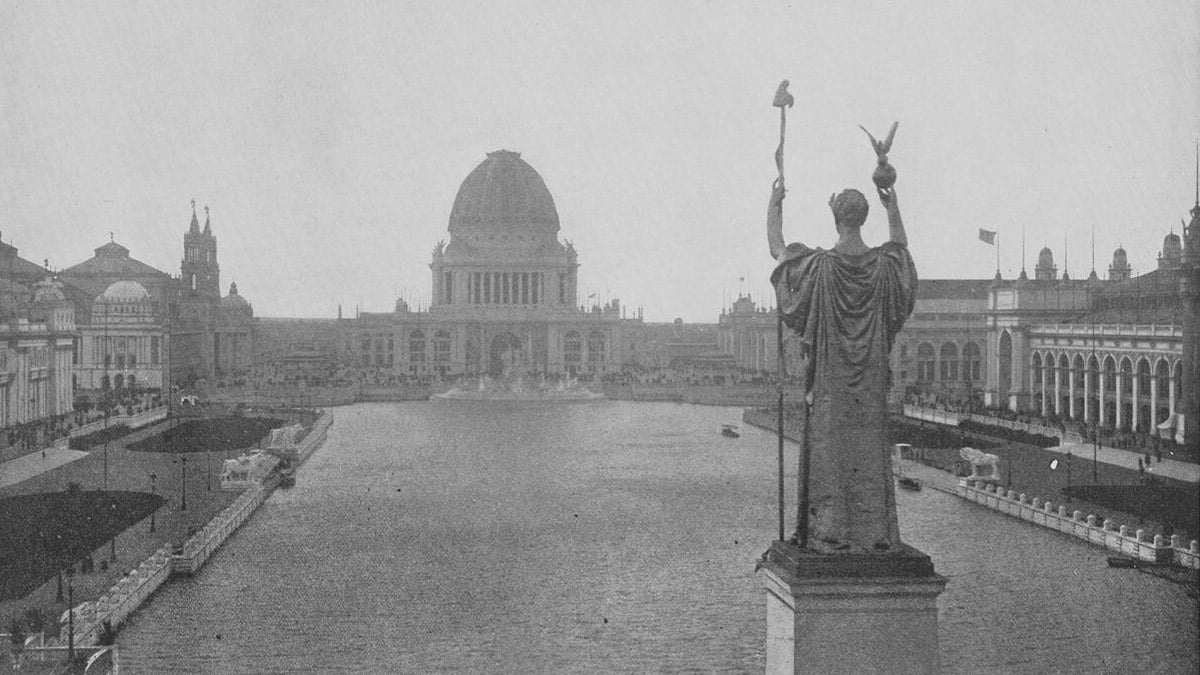
Despite being built for temporary purposes, the fair still had many noteworthy buildings that resembled the golden age of ancient Greece. At it's entrance coming from the Terminal rail station was the Admin Building which soared into the sky with it's massive domed cupola. This was the center for the fair's event staff, a building that resembled the white house capitol or the St. Paul's Cathedral. Then there was the Manufacturers and Liberal Arts building, a behemoth exhibition hall that stood as the largest building in the world for sheer space volume. Other notable buildings included the Women's Building, the Machinery Building, and the Electricity Building. The only building built for the long term was the Gallery of Fine Arts (done so to protect these expensive gems). It is the only building that still stands to this day now as the Museum of Science and Industry.

The electricity building was one of the more popular attractions within the fairgrounds. The electrical contract of the fair went to Tesla's Westinghouse Electric company instead of Edison's General Electric. Here in this central building were the latest technologies of the kinetoscope, search lights, incubators, seismograph, generators, and so forth. Both Edison and Tesla themselves showed up to the fair to give various demonstrations. Outside the main building there were exterior lights, spotlights, and even fountains with illumination. To see the fair lit up at night in 1893, must have been a very new and surreal experience for most citizens.  

At the center of the fairgrounds was a giant pool basin that housed the impressive Statue of the Republic (one of the iconic symbols of the event). Behind this pool was an impressive peristyle of Greek pillars, connected to a pier with a moving walkway, that overlooked the mighty Lake Michigan. The southern perimeter housed the livestock exhibits as well as the German guns and artillery of Friedrich Krupp. In the waters were replicas of the Columbus ships, as well as various smaller sailboats, gondolas, and foreign rowboats. To the north was the wooded island a popular scenic getaway that housed gardens and the Japanese pagoda surrounded by a lagoon. At the west of the fairgrounds was a long strip of entertainment, known as the Midway Plaisance. This housed all sorts of amusements, rides, and entertainment such as an ice ring and most famously the first ever Ferris Wheel. This behemoth construction was considered the answer to the Eiffel Tower and it's most popular attraction. It stood 264 feet and held 40 cars that could house 60 people at a time.    

Along the perimeter of the fairgrounds were exhibits and buildings from 46 countries and all 50 states represented. The German Pavilion was one of the larger more impressive buildings alongside it's Krupp artillery building. Norway sent a replica of a 9th century Viking ship which sailed across the Atlantic. While the fair was inclusive of most nationalities and even women's rights it failed to bring attention to African American culture. There were many cases in which black citizens were not allowed entry into the main fairgrounds, only the Midway region (which housed most of the indigenous/exotic races) thus the term "White City" was used as a controversial term. Aside from it's controversies, crime, and scandals however the architecture was surreal and groundbreaking. It ushered in a new renaissance of urban development and beautification of cities all across the United States. 

The Fair's Legacy

The fair was ultimately a successful demonstration of American exceptionalism and a great response to the Paris Exposition of 1889. It demonstrated the might of America, yet more so the resilience of Chicago especially after the devastating effects of the Great Chicago Fire of 1871. The fair was later commemorated in Chicago's state flag with a star. Nearly ten years later America would double this effort with it's St. Louis 1904 fair. While the fair covered more area with more exhibits it did not surpass the attendance of the Chicago Exposition. Today world fairs are a thing of the past and none came close to the sheer scale of Chicago's event in 1893. Even modern theme parks and Olympic sites could not compare with this architectural paradise. 

New Inventions and Debuts at the fair

  • The Pledge of Allegiance
  • The term, "Windy City"
  • Cream of Wheat
  • The Brownie
  •  Hershey's Chocolate
  • Juicy Fruit gum
  • Quaker Oats
  • Shredded Wheats
  • Pabst Blue Ribbon beer
  • Aunt Jemima's syrup and pancake mix
  • Cracker Jacks
  • Vienna Beef hot dogs (now a staple of Chicago)
  • 1st Moving Walkway
  • The Ferris Wheel
As the fair ended, the city was shocked by the assassination of their mayor Carter Harrison, who gave a speech earlier that day. He was murdered by Patrick Prendergast who was upset he did not receive a position the mayor had promised him. The fair came to an official close on Oct 31st with a ceremonial burning of most the temporary buildings. The iconic Ferris Wheel was dissembled and relocated to north Chicago for a while, then to the St. Louis Fair of 1904. It was later used for scrap metal. Today Jackson park remains with the Museum of Science and Industry (the only surviving building of the fair). There is also a golf course, the Japanese garden on the wooded island, and the Midway Plaisance remains as a long grass field connected to the University of Chicago. A replica of the Statue of the Republic also stands at the heart of the park to commemorate this historical event. For six months in the summer of 1893 Chicago had amassed the largest gathering of humans to truly become the center of the world. 

Monday, May 29, 2023

Movie Review: Guardians of the Galaxy Vol 3

Seems like always around Memorial Weekend there's some new Marvel movie to watch. I'm not crazy about the super hero movies, but I do enjoy the special effects and witnessing them on the big screen. It's especially quite nostalgic to watch a summer blockbuster at the movie theaters, an experience I cherished during my teenage years. The smell of popcorn, watching the previews, and just sharing those real emotions and reactions with total strangers. It's rare for me now, but I still find it to be quite an enjoyable recreational activity. It's nice that I can occasionally share this with my younger nephews. 

Of all the many Marvel Avenger stories, I would say the Guardians of the Galaxy is probably my favorite. It was first released in 2014 and I honestly had never heard about the superhero story. I remember it was quite popular at the Indians ballpark amongst our video and promotions crew. I finally did catch it on the big screen and instantly enjoyed everything about the movie. Not just the science fiction action, but the actors, the classic rock soundtrack, and the nonstop comedy. The writing and comedic chemistry  throughout the movie is sensational. This was the case for the first movie (2014) and even more so for the second movie (2017). Five years later this newest movie marks the third installation in the series. 

The Premise

Following their epic fight the celestial Ego and the events of the Inifinty War, the Guardians of the Galaxy reside in the region of Knowhere. Peter Quill is depressed that Gamora was killed by Thanos, while the rest find some semblance of normalcy. This is all abruptly changed when Rocket is attacked by an assassin from the Sovereign race. He is put on life preservation and the Guardians must use all their powers to find how to save him. During his unconsciousness the backstory of Rocket is shared in which he was created as a scientific experiment by the wicked High Evolutionary. He befriends several other animal-humanoids such as him but they are later killed by the OrgoCorp and Rocket is able to escape.

Peter Quills calls on the help of the Ravagers to infiltrate the OrgoCorp where they can find more clues about Rocket's mysterious condition. Here the Guardians are reunited with an alternate version of Gamora (who does not remember Quill or any of the guardians). After a series of fights they are able to locate Rocket's secret file which details his experimentation, however they are still missing the key to curing him. So they continue their journey to the Counter-earth, a planet of animal-humanoids created by the High Evolutionary. Quill, Groot, and Nebula are able to locate the Orgo Lab on the planet where they confront the High Evolutionary. He shares his vision of a perfect society, however admits that it is flawed and decides to destroy it there in that moment. Quill and Groot are able to escape and find the missing key to cure Rocket. However Drax, Mantis, and Nebula board the Lab spaceship in an effort to rescue Quill.

Back on board the Guardian's spaceship Quill and Groot reunite with Gamora and are able to revive Rocket. They then launch an offensive against the Orgo Spaceship, intending to save Drax, Mantis, and Nebula. They later discover that there is a whole colony of imprisoned children and animals on board the ship. The Knowhere spaceship comes to the Guardian's aid and fires heavily upon the Orgo spaceship and a major battle ensues. The Guardians are eventually able to free the children and the animals and defeat the High Evolutionary. Their victory is short lived as the Guardians decide to dissemble. Gamora returns to the Ravagers, Mantis decides to go on her own adventure, and Peter Quill returns to earth to find his grandfather. 

The Review

The movie was good with lots of laughs, exhilarating action, and incredible special effects. I will say offhand that it was not quite as good as part 1 or part 2. For me the dynamic was a little off with Gamora not recognizing the rest of the crew. While she still played the cold serious one in the group, I felt she was too disconnected from the rest. Groot wasn't quite as adorable as he was in the 2nd movie and Rocket was out of commission most of the movie. Surprisingly one of the break-out characters in this one was Mantis who had lots of funny and heroic moments. Quill, Drax, and Nebula also offered some good comedy and content. The soundtrack was okay but also not as good as the first two movies.

With all that said I still enjoyed the movie and would consider it my favorite of the Marvel series (even ahead of Thor and the Avengers series). I do think the ending was rather unresolved and really hope there is a sequel if not a few more after that. To see the Guardians break up is not at all how the story should end. I believe this film series has the potential to expand beyond Marvel, into it's own sci-fi universe with endless content and character spin-offs. With its unique style, setting, and characters, the story of the Guardians of the Galaxy has the potential to rival other major Sci Fi Universes such as Star Trek or even Star Wars.