Showing posts with label Biblical. Show all posts

Sunday, April 13, 2025

Biblical Study: The Age of Kings and Prophets

Following the legendary reigns of King Saul and King David, the monarchy passed to David's son Solomon. Well renown for his wisdom, Solomon built the first temple to honor God and establish Israeli respect within the Mesopotamia region. The kingdoms of Israel and Judah later split after his reign however both endured many foreign wars. The Kingdoms of Israel and Judah prospered from 1000 BC to 600 BC with a total of 42 kings throughout this 400 year period. They were eventually conquered by the Neo-Babylonian empire under Nebuchadnezzar in 587 BC and put into captivity for some time. They were later freed by Cyrus the Great in 538 BC to return to their homes as a Persian vassal state. 

A new Israeli dynasty was briefly established in 140 BC when the Hasmoneans defeated the Seleucid Empire. As this point in history both the Greek and Persian empires were on the fall to the rise of the Roman Empire. Israel established an alliance with Rome, which allowed them to have their own monarchy for 103 years. That is until they became a puppet state of the Roman Empire in 37 BC during the reign of King Herod the Great. During this time insurgency arose once again, however the Romans ultimately crushed the resistance. In 70 AD the Romans lay siege to Jerusalem and destroyed their second temple which marked an abrupt end to Jewish influence in the land of Israel. 

During this age of kings, the prophets also played a key role as leaders and consultants. They were considered the voices of God, and would often relay this message to the king and the people. One of the most important of these prophets was Samuel, the king-maker. It was he who helped establish the kingdom of Israel by guiding both Saul and David. He was then followed by Nathan, Elijah, Elisha, and many others thru the early portions of the monarchy. At various stages throughout Israeli history these prophets were considered as leaders of the people.

The Reign of Solomon

The son of David and Bathsheba, Solomon became the 4th king of Israel and considered as one of the greatest. He was not a war tyrant like his predecessors but rather a devout prophet of great wisdom. For this reason God chose him to build the first temple that would host the Ark of the Covenant in Jerusalem. His wealth and wisdom became famous throughout the land, as demonstrated by the ceremonial visit of Queen of Sheba. Perhaps one of his most famous trials of judgement was when he heard the case of the two women. One had lost a child and accused the other of stealing it. In order to seek the truth Solomon suggested the child be killed, and therefore the true mother revealed herself in her love and emotion for her child. 

Aside from his wisdom, wealth, and various construction projects (such as his lavish throne) Solomon also dealt with internal enemies. The first of these enemies was his brother Adonijah, and the commander Joab who had wronged Solomon's father David on various occasions. Joab was eventually killed by Solomon's new appointed military commander Benaiah. Perhaps Solomon's greatest sin was the numerous wives and concubines he took, some of which turned him away from God. This was because he had taken on foreign wives, from the lands of Moab, Ammon, Edom, Sidon, Hittites, and Egyptians who worshiped other gods. According to the bible Solomon had 700 wives and 300 concubines. He reigned for 40 years and passed the monarchy to his son Rehoboam.   

The Split of Israel and Judah

The land of Israel and Judah were united under the reign of King David, however there was still tension amongst the two. After the death of Solomon, his son Rehoboam quickly lost favor with the northern Israelites. Israel thus declared their own king, in Jeorboam who lead a revolt against King Rehoboam. After nearly 20 years of civil war, the Israelites left the House of David (in Judah) to establish their own kingdom (Israel), with their new capital in the city of Samaria. Thus there were now two kings of the Hebrews; Rehoboam reigned the Kingdom of Judah from 922-915 BC, while Jeroboam reigned the Kingdom of Israel from 922-901 BC.  

The Book of Kings then goes on to describe the reign of each king during this historical period. It's quite fascinating at this point, since these are all indeed historical kings that deal with historical issues. The bible however demonstrates that each king's reign was decided not upon their merit, but rather their faith in God. Thus a good majority of the kings of Israel and even Judah did evil in the eyes of the lord and for the reason their people suffered. One of the more favorable gods of the Israelites was Jehu (841-814 BC) for having destroyed the cult and temple of Baal. The Kingdom of Israel was the first to be conquered by the Assyrians in 722 BC under the reign of King Hoshea.   

It seems clear in the Book of Kings and Chronicles, that God took favor with the Kingdom of Judah over Israel. There are far more "good" kings of Judah then there are of Israel, Such as King Asa (911-870 BC) who rooted out idolatry and defeated the Ethiopians. His son Jehoshaphat (870-849 BC) who solidified the Kingdom of Judah against it's enemies such as Israel as well strengthening the laws of Moses. The King Jotham (740-732 BC), who honored God by expanding the Temple and fought successful wars against the Arameans and the Ammons. King Hezekiah (739-687 BC) who also helped improve the temple, destroy any forms of idolatry, and defeated the enemy Philistines. Hezekiah was also able to make peace with the Assyrians in 701 BC. King Josiah (640-609) also made significant contributions and reforms to the Jewish law of God. Zedekiah was the last king of Judah, after it was conquered by Nebuchadnezzar in 597 BC and the temple was destroyed.

The Kings of Israel and Judah

United Monarchy

  • Saul  (1020-1000 BC) 
  • Ish-Bosheth (1000-998 BC) 
  • David (1000-962 BC)
  • Solomon (962-922 BC)
  • Rehoboam (922-915 BC)
Kingdom of Israel (Northern Kingdom)
  • Jeroboam (922-901 BC)
  • Nadab (901-900 BC)
  • Baasha (900-877 BC)
  • Elah (877-876 BC)
  • Zimri (876-885 BC)
  • Tibni (876-885 BC)
  • Omri (876-869 BC)
  • Ahab (850-849 BC)
  • Ahaiah (850-849 BC)
  • Joram (849-842 BC)
  • Jehu (842-815 BC)
  • Jehoahaz (815-801 BC)
  • Jehoash (801-786 BC)
  • Jeroboam II (786-746 BC)
  • Zachariah (746 BC)
  • Shallum (745 BC)
  • Menahem (745-738 BC)
  • Pekahiah (738-737 BC)
  • Pekah (737-732 BC)
  • Hoshea (732-722 BC) 

Kingdom of Judah (Southern Kingdom)

  • Abijah (915-913 BC)
  • Asa (913-873 BC)
  • Jehoshaphat (873-849 BC)
  • Jehoram (849-842 BC)
  • Ahaziah (842 BC)
  • Athaliah (842-837 BC)
  • Jehoash (837-800 BC)
  • Amaziah (800-783 BC)
  • Uzziah (783-742 BC)
  • Jotham (742-735 BC)
  • Ahaz (735-715 BC)
  • Hezekiah (715-687 BC)
  • Manasseh (687-642 BC)
  • Amon (642-640)
  • Josiah (640-609 BC)
  • Jeoahaz (609 BC)
  • Jehoiakim (609-598 BC)
  • Jehoicachin (598 BC)
  • Zedekiah (597-587 BC)

Babylonian Captivity

The destruction of Solomon's Temple in 597 BC by the Babylonian Empire marked an end to both the ancient kingdoms of Israel and Judah. None of which would return to their former glory yet rather a vassal state of larger empires. The majority of Jewish population were deported into Babylon in 2 waves. 1st in 597 when Nebuchadnezzar sieged the city of Jerusalem, took some prisoners, while allowing the state to remain and pay him tribute. Then in 587 Nebuchadnezzar returned to destroy the city outright, under King Zedekiah, after it failed to pay him proper tributes. Although the entire city of Jerusalem was deported into Babylon, the rural pockets of Judah were able to remain. It is estimated that 25% (20,000) Jews were sent into exile.

However it should be noted that although they were uprooted from their homeland, they were not entirely made into slaves (as they were in Egypt). Most of the Jews were allocated to the outskirts of the city, where some lived a privileged life, while others were forced to work in agriculture or labor camps. Nonetheless they were still able to practice their religious beliefs and Mosaic traditions. In 539 BC, Cyrus the Great led his Persian army to conquer the Babylonian Empire of which he later freed the Jews. After 60 years in exile the Jews were able to return to their homeland, however as a vassal state of the Persian Empire.

The Second Temple

Upon returning to the land of Israel the Jews no longer had kings to lead them, yet rather high priests and prophets. One of the first notable leaders was Zerubbabel, his prophets Haggai, Zechariah, and his high priest Joshua who began construction on the Second Temple from 521-516 BC. The laws and practices of the Jewish people were later enforced by the prophets Ezra and Nehemiah. Ezra emphasized the importance of the Torah and to not interact with foreigners, while Nehemiah also implemented religious reforms and rebuilt the walls of Jerusalem. Although their state was still under Persian control, the Jewish solidified their religious law and practice during this period.

Perhaps one of the most well known biblical stories also occurred during this time, that of Esther. Whether fictional or historical it served as a great allegory to the presence of God during trying times. She became wife to the Persian King Ahasuerus (otherwise known as Xerxes) and was able to convince him from saving the Jews from the wrath of the wicked advisor Haman. After being offended by the Jewish advisor Mordecai, Haman plotted to kill all the Jews, however thanks to Esther the King intervened and had Haman executed. This triumph later became celebrated in the Jewish festival of Purim, giving praise to God for surviving annihilation at the hands of the Persians. 

The Prophets

During this age of Kings throughout the Old Testament there were several important prophets who imposed the will of God to the Israelites. They often served at the hand of the king or as influential elder priests who oversaw the law of God. There were four major prophets and twelve minor prophets before and after the exile. The four major prophets were Isaiah, Jeremiah, Ezekiel, and Daniel (all with books of their own. The twelve minor were Hosea, Joel, Amos, Obadiah, Jonah, Micah, Nahum, Habakkuk, Zephaniah, Haggai, Zechariah, and Malachi.

  • Joel (850 BC) - Prophesized on the plague of locusts
  • Jonah (800 BC)- He disobeyed God's call to preach to the city of Nineveh, and thus was punished by being swallowed by a whale. For three days he dwelt within the whale, and prayed to God until he was released. 
  • Amos (780-755 BC)- Spoke out against the social injustice against the poor and the corruption of the wealthy
  • Hosea (760-710 BC)- Spoke out against idolatry and prophesized the doom of northern Israel.
  • Micah (740 BC)- Prophesized against social injustice, the downfall of Israel, and the birth of a messiah in Bethlehem.  
  • Isaiah (740-680 BC)- One of the most well known of the prophets thru his Book of Isaiah. He prophesizes on the coming of the Messiah, of his death and the resurrection. He warned Israel from it's sins and it's downfalls and looked to a new savior to bring them salvation. 
  • Nahum (666-615 BC)- Prophesized the downfall of the Assyrian empire and the city of Nineveh to bring comfort to the Jews
  • Zephaniah (630-620 BC)- He prophesized the destruction of Jerusalem if the people did not repent
  • Habakkuk (627-587 BC)- Prays for the injustices and questions why God allows evil to occur
  • Jeremiah (626-580 BC)- The author of the Book of Jeremiah and Lamentations he is considered the weeping prophet for his prophecies on the fall of Jerusalem due to their disobedience to God. 
  • Daniel (604-535 BC)- Known as an interpreter of dreams, he consulted the King Nebuchadnezzar before he was thrown into a lion's den for not worshiping him. Daniel is saved by the grace of God, and then goes on to prophesize on the coming of a new Messiah in his Book of Daniel.
  • Ezekiel (593-570 BC)- Prophesized the restoration of the Israelites thru visions, including his most famous one in the Valley of Dry Bones. In this vision he saw the dry bones of the dead rising up to life, to symbolize the resurrection of Israel. 
  • Obadiah (585 BC)- He condemned the nation of Edom for their wickedness towards Israel, as well as the message of humility
  • Haggai (520 BC)- He is best known for encouraging the Israelites to rebuild the Second Temple after returning from Babylonian captivity
  • Zechariah (520-518 BC)- He also urged the construction of the Second Temple, and shared his visions of God's plans to restore Israel thru a Messiah
  • Malachi (450-400 BC)- Called the Israelites into repentance and prophesized on the coming of a messenger (John the Baptist) who would prepare the way for the lord.

The Maccabean Revolt

In the Book of Maccabees the rise of Alexander the Great is recounted who conquered the Persian Empire. The region of Israel then became a state of the Ptolemaic Kingdom (which was the Greek-Egyptian kingdom of Alexander). Israel remains under Ptolemaic control from 300-200 BC until they are conquered by the Seleucid Empire (also a former kingdom of Alexander). It is at this point that the Jews rise up again to lead a revolt to restore their monarchy. They are led by Judas Maccabeus in the year 167 BC in what is known as the Maccbean Revolt against the Seleucid Empire which lasted until 141 BC.

The bible recounts how Judas Maccabeus and his brothers Jonathan and Simon prayer to God to deliver them victory as he once did with Moses, Joshua, and David. Thru various battles and over twenty years of fighting the Israelite rebels are finally able to achieve independence in 141 BC. The first feast of of Hanukkah is celebrated to commemorate the recapture of Jerusalem and the Second Temple from Seleucid control. Simon is able to secure a peaceful alliance with the Roman Republic and establishes the Hasmonean Kingdom in Israel. From 104-37 BC there are 6 more kings to reign over Israel, until they are once again subjugated this time by the Roman Republic.     

The Roman Destruction of Jerusalem

In 37 BC King Antigonus II Mattathias became the last king of Judea until he is overthrown by Herod the Great at the behest of the Roman Republic. Thru strong ties with Julius Caesar, Herod becomes appointed as 1st governor of the newly established province of Rome. Despite helping bring an end to the Hasmonean Dynasty, Herod is still a devout Jew and makes great contributions to the city of Jerusalem. He renovates and expands the Second Temple by building the Western Wall in 19 BC (which still stands to this day). However Herod is often criticized as a great villain during the Nativity Story, by which he seeks to hunt this coming Messiah and slaughter thousands of innocent children. After Herod's death in 4 BC the kingdom of Judea was further divided into smaller Roman provinces among his sons. 

By this point the Roman Republic had transformed into a Roman Empire under Augustus by which Roman prefects oversaw the affairs of Judea. It is also quite significant that during this time Jesus of Nazareth began his life (approx. 4 BC-33 AD) considered as the new Messiah of God. His ministry took a significant hold throughout Jerusalem, of which he was later executed by Jewish elders. However Jesus' religious movement (that would eventually inspire the spread of Christianity), was merely at the backdrop of a rising political insurgency throughout Judea. 

Known as zealots, many insurgents throughout Judea began to publicly oppose Roman occupation. This wave of Jewish nationalism grew after Herod's death with a desire to replicate the successful Maccabean Revolution over the Seleucid Empire 200 years earlier. The first Jewish outbreak of rebellion against the Romans occurred in 66 AD which brought a start to the Jewish-Roman War of 66-74 AD. The Jews achieved a significant victory at the Battle of Beth Horon to briefly establish it's own government in Jerusalem. However it was quickly crushed by the Roman armies under the command of Vespasian and Emperor Titus. In 70 AD the Siege of Jerusalem occurred which destroyed the second temple and once again completely subjugated the Jews. This marked a major turning point in Jewish history, where they were sent into a diaspora away from Israel.         

Sunday, April 6, 2025

Biblical Study: The Story of David

One of the most famous figures in the Hebrew Bible is that of King David due to the epic nature of the story. His is a rags-to-riches tale, a shepherd chosen by God to lead and reign over the Israelites. Perhaps his greatest claim to fame was defeating the mighty Goliath, which has become the most common metaphor of any underdog competition. However this was only the beginning of his tale. He then became the 3rd king of Israel, lead many successful military campaigns and established the city of Jerusalem as the capital of Judah. As a musician and a poet he is credited with writing many of the biblical proverbs and psalms. The historical accuracy of his reign is often disputed alongside Saul but it is estimated this would be around the time of 1000-962 BC. His biblical story is recounted in the Books of Samuel, Kings, and Chronicles. 

His story from shepherd, to warrior, to lover, to sinner, and to musical poet is truly the stuff of a Hollywood epic motion picture. Which is no doubt why he is celebrated in so many great artworks such as Michaelangelo's statue. It's quite surprising there has yet to be a biopic film of his life to match the epic scale of the Ten Commandments or The Passion. However the recent television series of House of David on Amazon has provided great quality and detail on the story. This was ultimately a man who was rich with faith in God, and thru this faith he achieved great glory. However despite winning the favor of God throughout his lifetime, he still endured many conflicts and troubles during his reign. Perhaps his greatest sin of all was that of Bathsheba, which I believe somewhat taints his overall righteousness. Nonetheless he was considered by the Jews as their greatest king and disciple of God, which is demonstrated in their primary symbol, the Star of David.

The Battle with Goliath

God eventually loses favor with King Saul, after he does not fully obey the Lord's commands to slaughter the king of Amalek. This brings great despair and torment to Saul which will eat away at him until the end of his life. He is able to find temporary peace from the young shepherd boy named David, who plays the harp for him. David is the son of Jesse, from Bethlehem, the tribe of Judah, who is devout in his faith.. As a young boy David has killed a lion and a bear, has heard the calling of God, and is anointed by the prophet Samuel as the new chosen one. Little does King Saul know that this young boy playing the harp for him, has now overtook God's favor from him. 

When the Israelites go to war against the Philistines, they are faced with a tremendous foe named Goliath, who stands 6.5 feet tall. Goliath offers a challenge that any Israelite come to face him as he defies their God. The Israelites however are consumed by fear and none step up to his challenge, until the young David arrives. David presents his case to the army and then to King Saul, stating it is not about the greatest of Goliath, rather the greatness of God. He is able to convince Saul to allow him to be Israel's chosen champion to fight the Goliath. David chooses not to wear armor yet to only equip himself with a slingshot and 5 stones.

David then confronts Goliath and tells him he will cut off his head for insulting the lord. At this point David hurls his slingshot, where the stone embeds itself in Goliath's forehead and kills him instantly. David then proceeds to use Goliath's sword to cut off his head, and present it to the field of battle. This becomes a rally cry for the Israelite army who send the Philistines into a retreat. Saul and his son Jonathan embrace David as the new hero of Israel, and many begin to sing of his praises. Saul offers his daughter Michal in marriage so that David would become his son-in-law.  

The Jealousy of Saul

David continues to fight and slay many Philistine armies under the command of King Saul. News of his victories spreads throughout the lands of Israel. Saul grows agitated at the songs that claim "he kills thousands, while David kills tens of thousands". He begins to sense that God has now chosen David as the favored successor to be king. Meanwhile his son and heir-apparent Jonathan feels no malice towards this opposition, yet rather shows loyalty and love towards David. And David loves him in return, with subtle hints of a homosexual relationship. Jonathan later warns David, that his father intends to kill him. David begins to amass a great following and army in the land of Judah, however does not seek to usurp King Saul.

On various occasions Saul attempts to entrap or have his army defeat David in battle but continuously fails at these plots. David becomes aware of the king's resent towards him and at one point he confronts and spares the life of Saul. This only drives Saul into further remorse and madness who later turns to the Witch of Endor to help him find counsel. The Witch uses necromancy to rise up the dead spirit of the prophet Samuel. Samuel informs Saul that God no longer favors him and further more he will die in the next battle against the Philistines. This harsh prophecy comes to reality the following day when Saul and his sons (including Jonathan) are killed in battle.

David becomes King

Following the death of King Saul, his son Ishbaal became king over Israel for a brief two years. Meanwhile David reigned over the kingdom of Judah yet mourns the loss of Jonathan, whom he loved. Civil war wages for a couple years between the House of Saul and the House of David until Ishbaal is killed. David then becomes the sole ruler of a unified Israel and turns the city of Jerusalem as it's capital. He brings the ark of the covenant into Jerusalem and intends to build a great temple to house the ark and honor the lord, however the prophet Nathan forbids it. God makes it clear that David has shed too much blood to build his temple and that this honor should go to his son (Solomon). 

From his new capital city in Jerusalem, also known as Zion, David waged many more military campaigns. He achieved victories against the Philistines, the Moabites, the Edomites, the Amalekites, and the Ammonites. With each victory he achieved more wealth and power for Israel against it's neighboring lands. He also shows favor to the House of Saul, since he loved Jonathan, and welcomes Jonathan's son Meribbaal to eat at his table. From then on the House of Saul no longer opposed David's rightful rule as king. 

David's affair with Bathsheba

In a unique twist on what appeared to be a man of pure righteousness, David later commits a terrible sin of wickedness. He spies a beautiful woman named Bathsheba, and commits adultery with her. While it was common for a king to take on mistresses and concubines, to seek a married woman like this was a total sin. But that was only a minor part of the sin and the greater sin came in what he did to Bathsheba's wife. Knowing that Bathsheba was likely pregnant with David's child, he ordered that her husband fight and die on the front lines of battle. David then married the widowed Bathsheba, who gave birth to four of his children including Solomon. 

The prophet Nathan later discovers this great sin and confronts David by telling him God is aware of this great sin and that he will forever be punished for it. His punishment is that his first son will die, and great evil will come upon his house (which is a later reference to the rebellion brought on by his son Absalom). From this point on David is humbled once again, mourns for some time, and then returns to great prayer and devotion to the Lord. God later forgives David for his sincere repentance and takes favor on his newly born child Solomon, who will build the temple of the lord.

The Rebellion of Absalom

As part of David's punishment for his great sin, God later turns his son Absalom against him. The young Absalom kills his brother and heir-apparent Amnon for raping their sister Tamar. Absalom then went into exile for three years before he returned to Israel to lead a revolt against his father. He eventually wins favor of the people and declares himself king over Hebron, the former capital of Judah. He amassed a great army, causing David to flee Jerusalem. David then enlists his servant Hushai to infiltrate Absalom's counsel. Hushai is able to manipulate Absalom into not attacking David's fleeing forces yet to rather build up the defenses of Jerusalem. This gives David time to regroup and rebuild his own forces.

David then enlisted the commander Joab to assault the armies of Absalom but gave specific instructions that his son Absalom was not to be harmed. At the Battle of the Wood of Ephraim the army of David met against the army of Absalom. There were twenty thousand casualties in this battle in the forest where Joab's army defeated Absalom's rebellion. Absalom famously died during this battle when his long hair got caught in a branch and his horse rode away. Hanging from a tree, the commander Joab thrust his spear to kill the young prince, and disobey David's request that his son not be harmed. David is once again tormented by grief at the news of the death of his son Absalom. 

His Final Years

After the rebellion of Absalom comes to an end, David returns to Jerusalem to continue his reign over Israel. However the kingdom is beginning to show signs of frailty due to David's remorseful state. The commander Joab confronts David for lacking gratefulness to the army that brought him defeat against this son's uprising. Further division begins to grown between the kingdoms of Judah and Israel, of which another civil war breaks out lead by the Benjaminite, Sheba. David appoints Amasa to lead the assault against Sheba, however feeling betrayed Joab kills Amasa to continue his command of the army of David. Once again Joab achieves the military glory by defeating Sheba and squashing another rebellion. 

It is likely in his final years that David spent most his time in prayer to God, writing his famous psalms of prayers, poems, and songs to the lord. His eldest son Adonijah began to show ambition to take the throne and established a partnership with the ruthless commander Joab. However the prophet Nathan made Bathsheba and David aware of this plot, and convinced David to proclaim Solomon as the rightful heir and king of Israel. Before David's death his final instructions to his son Solomon was that Joab was to be killed for his disobedience. He also told him to keep true to the Lord's mandates honoring the laws of Moses and to build him a temple worthy of his name. David then died, having ruled over Israel for 40 years, and was buried in Jerusalem. 

Sunday, March 30, 2025

Biblical Study: The Age of Judges

Following Joshua's campaign to conquer the land of Canaan and deliver the Israelites to the Promise Land, the Book of Judges recounts the leaders of Israel. During this age of approximately 350 years, Israel was divided into the 12 tribes of Jacob, and were lead by notable leaders referred to as judges. This was prior to the establishment of the Kingdoms of Israel and Judah. The historical accuracy of this book is debatable however it certainly pertains to the real legends and tales of the Israelites. The approximate timeline here would be 1360 BC (when Joshua conquered Canaan) to 1024 BC where Saul became the first king of Israel. 

These are some of my favorite books in the bible that pertain to the historical foundation of the nation of Israel. The books are loaded with military campaigns against the neighboring Philistine and Arab tribes, while also internal power struggles. God is of course the driving force of it all, but has not chosen an individual leader to succeed Joshua. Instead Israel is divided into various tribe and leaders (referred to as judges). God frequently grows frustrated with the Israelites as they take on neighboring gods such as Baal and Dagon and punishes the with defeat and famine. However they always realize their errors and return to give praise to God.

The 12 Tribes

The land of Israel was divided into 12 regions, based on the tribes and descendants of Jacob. This included Asher (symbol of a tree), Dan (symbol of justice), Judah (the crown), Rueben (a mandrake), Joseph (a palm tree), Naphtali (gazelle), Issachar (sun, moon, and stars), Simeon (towers and cities), Benjamin (jug, ladle, and fork), Gad (tent, cattle), Zeublun (ship, sea), and Levi (priests).  The Tribe of Levi was appointed 6 cities of refuge, while the tribe of Joseph was divided into two land allocations in Manasseh and Ephriam. However of these 12 tribes, only 2 of them played a vital role in the development of Israel. This included Judah and Benjamin who inhabited the heart of Israel, in Jerusalem. The other 10 tribes were supporting players, who would later become referred to as the Lost Tribes.

Following the death of Joshua, the Israelites asked God who would lead them next against the Canaanites. God did not chose an individual leader yet rather the tribe of Judah as his chosen people. The land of Judah then allied with the land of Simeon to defeat their neighboring enemies. However a recurring theme then begins in which the Israelites commit infidelities' against the Lord by adopting the gods of their neighbors. Since God is notorious for being a jealous god, he turns his back on the Israelites and lets them fall against their enemies. Finally the Israelites call out for a leader, and God appoints the first of various judges.

The 12 Judges

The first leader god appoints to judge over the Israelites is Othniel, from the tribe of Judah. Othniel redelivers victory against the Canaanites and then overseas an era of 40 years of peace for the Israelites. Ehud was then chosen to succeed him, from the house of Benjamin. His claim to fame was assassinating the enemy Moabite king with his left hand. He was then followed by the judge Shamgar who slaughtered 600 Philistines with an ox goad. Then came the first female leader of Israel, Deborah who served as a prophetess of God. She instructed the military commander Barak to lead an assault on the Canaanites at the Battle of Mount Tabor. She then gave a victory hymn, known as the Song of Deborah, regarded as the oldest Hebrew text in the bible.

Under Deborah's leadership Israel was at peace once again for 40 years, until her time passed. The Israelites once again turned against God and came under the power of the Midianites. Once again the Israelites called out for a leader, and God chose Gideon as his new champion. Gideon was from the half-tribe of Manasseh and had early doubts as to why God had called upon him. He famously tested the Lord to keep a fleece dry amidst a wet ground. Of course this goes against God's principle rule that faith in him should not be tested, he still performed the miracle so that Gideon would believe. With this act, Gideon knew he had the support of God and lead a small outnumbered army of 300 men to defeat the Midianites once and for all.

Once again the land of Israel was at peace for 40 years under Gibeon, until his son Abimelech took power with greedy ambition. Abimelech killed 70 of his brothers so that he would be the sole ruler of Manasseh the destroyed the Canaanite city of Shechem. During his siege of Thebez, a woman hurled a stone at Abimelech, that crushed his head and killed him. Abimelech's final command was to be speared by one of his own soldiers so that he would not die at the hands of a woman. Following the death of the wicked Abimelech, God once again showed favor in selecting Tola to lead the Israelites. Tola was from the Tribe of Issachar and lead Israel for 23 years. He was followed by the judge Jair from the House of Manasseh, who judged Israel for 22 years. 

After 40 years of strong leadership under Tola and Jair, the Israelites once again offended the lord by worshiping the Arab gods and came under oppression by the Ammonites. God then chose Jephthah, son of a prostitute from the city of Gilead, to lead the Israelites against the Ammonites. Jephthah made a vow with God, asking him for victory in return he would sacrifice whoever greeted him first at his house. God thus delivered the Ammonites into Jephthah's power, however when he returned hiome the first one to enter his house was his young daughter playing the tambourine. Jephthah mourned at his vow, but his daughter accepted her fate and requested two months to mourn, before she was put to death as a sacrifice to the lord.

The Mighty Samson

Jephthah judged Israel for six years and was then followed by Ibzan who judged for seven years, Elon who judged for ten years, and then Abdon who judged for eight years. After the death of Abdon, Israel once again fell into a leaderless void where they returned to the pagan gods. And once again God turned his back on them, and delivered them to the Philistines. However an angel later visits the infertile wife of Manoah and tells her she will bear a child (just as Mary bore Jesus). This child was to be named Samson who would lead the Israelites against the Philistine oppression. His body was consecrated by the lord, in which he would have tremendous strength as long as he did not consume wine nor cut his hair. He is without question the most famous figure in the book of Judges. 

In his youth Samson was attacked by a lion in the vineyards of Timnah, however he tore the lion to pieces and stole honey from the lion's belly. He then marries a prominent Philistine woman and offers a riddle to the 30 groomsmen in the wedding in exchange for garments. The Philistines are offended by Samson's mockery, and are able to convince his wife to find the answer. Enraged Samson goes to a nearby village to kill 30 Philistines, steal their garments, and offer them to the 30 Groomsmen as promised. He later discovers that his Philistine wife has remarried to one of the Groomsmen. Once again in a bout of rage, Samson gathers 300 foxes, lights their tails on fire, and sends them to scorch the grain fields of the Philistines. In response to this, the Philistines kill his wife and her father. 

Samson then began a fierce campaign of slaughter against the Philistines. He later took refuge in a cave known as the Rock of Etam. The Philistines then demand that the Israelites hand over Samson as prisoner. The Tribe of Judah approaches Samson with an army of 3000 and take him prisoner to hand over to the Philistines. However Samson breaks free and with the jawbone of an ass he slays 1000 Philistine soldiers. From this point on Samson became the hero and leader of Israel, and judged over them for twenty years. 

However towards his final years Samson once again fell in love with a Philistine woman, a prostitute from Gaza named Delilah. Just as his previous Philistine wife had done, she would also betray him to her kin (which explains why the Phantom of the Opera uses her name as reference). Delilah was able to learn that Samsun's superhuman strength came from his hair and cut it one night while he was sleeping. The Philistines were then able to easily capture him and gauge out his eyes. One day as the Philistines are celebrating a religious feast at the temple of Dagon, they call for their prisoner Samson to entertain them. Samson then prays to the lord, leans against the pillars of the temple, and brings them down to collapse the building. All 3000 Philistines in attendance are killed along with Samson. He is considered an epic hero with a tale quite similar to the Sumerian's Gilgamesh or the Greek's Herakles. 

The Book of Ruth

Towards the end of the age of judges there is a brief story in the Bible pertaining to a Moabite woman named Ruth. She embodies a Mary-like figure of piety, humility, and devotion to God. In the story she marries an Israeli named Mahlon who has moved with his family from Judah to the land of Moab. After ten years, Moab's father dies, his brother dies, and Moab himself dies. This leaves the mother Naomi alone with her two daughter-in-laws without any men in their family. The women weep for some time, unsure what to do, until Naomi decides it is best she returns to her home land of Israel. 

One of the daughter in-laws (Orpah) agrees with this plan to return to her Moab people, however Ruth decides to join Naomi on her return to Israel. She famously states that "where you go, I will go, where you lodge, I will lodge. Your people shall be my people, and your God my god. Where you die I will die, and I will be buried". This beautiful passage represents Ruth's devotion and loyalty to her family but also to God. Naomi and Ruth eventually relocate to Bethlehem, where Ruth finds work in the fields of barley. She later marries the owner of the field, Boaz who admires her devotion to Naomi. The two have a son named Obed, who has a son named Jesse, who has a son named David. Thus Ruth is the great-grandmother of King David.   

The Prophet Samuel

Another very important figure during the age of judges was the prophet Samuel who wrote the Books of Samuel which describe Israel's transition into a kingdom. He was the son of Hannah from Levi, who  prayed for a child, and God granted her prayer, thus she offered Samuel as a vassal of the lord. As a young boy Samuel was frequently called upon by the lord, of which he famously responded, "Here I am lord". The elder priest and judge Eli instructs him to respond to the lord, by stating, "Speak Lord for your Servant is Listening". God then explains that Eli's children have done wickedness and his dynasty must come to end. Shortly after this revelation, Eli dies and the Israelites are defeated by the Philistines who capture the ark of the covenant for some time.

Samuel becomes the leading prophet and judge of Israel after the death of Eli where he seeks to regain the ark from the Philistines. The Philistines later discover their statue of Dagon to be laying prostrate towards the ark, as a sign of worship. God brings forth great devastation upon the Philistine tribes until they return the ark to the Israelites. Finally after 20 years of oppression by the Philistines, Samuel leads the Israelite army to victory at the hill of Mizpah. Towards his elder years, the people of Israel begin to call for a king, which upsets God who sees it as an insult to his leadership. Nonetheless God grants their wish and appoints Saul from the house of Benjamin, to be the first king of Israel. 

The Rise of Saul 

Thus the prophet Samuel became the king-maker of Saul by anointing him and consulting him in battles against the Philistines. Samuel presents Saul as king to the tribe leaders which marks the beginning of the new unified kingdom of Israel. There are of course those within Israel who contest his leadership however after Saul defeats the Ammonites all tribes swear allegiance. Yet there are early warning signs of Saul's devotion to God and unwillingness to follow Samuel's instructions. At one point Saul decides to spare an Amalekite king, against God's instructions and for this he is condemned. God makes it clear to Samuel that he regrets choosing Saul as king which no doubt was intentional as he did not want a king in the first place.

Samuel confronts Saul one last time declaring how he has been disobedient to the lord and his dynasty would end with him. Saul is devastated at this news that he has loss favor with God and carries forth to kill the Amalekite king, but it is too late. Samuel then journeys to Bethlehem to seek out the young David, whom God has now chosen as the rightful successor to Saul. God of course would not undue his decision to make Saul king, however at this point his favor sharply shifts towards the young David. After the prophet Samuel dies, Saul becomes wicked with jealousy and malice towards David. 

Sunday, March 23, 2025

Biblical Study: The Campaigns of Joshua

I'm going to start a new series here in my blog on biblical studies (a sub-genre of my religious studies). I am a devout Christian and have always enjoyed the stories from the bible. Whether fictitious or historical (I believe there's a bit of both) these stories provide a poetic and powerful message of faith. Much of the Jewish, Christian, and even parts of the Islam religions are derived from the bible. The stories of the Old Testament pertain to the ancient customs and history of the Jews, while the New Testament pertains more to the Christians with the arrival of Jesus Christ. It consists of many books written by various prophets and theologians as far back as 1500 years ago. 

I remember first getting my Holy Bible in junior high school, the American version with nearly 1400 pages. I've somehow kept the same bible ever since and even after 25 years it's still in good condition. I made a major effort during college to read the book from start to finish (inspired by a course I waking on the Old Testament). I copied my dad's idea to underline the passages within the bible that I felt were inspiring or significant. Ever since I always keep my bible by my bed and try to make an extra effort to read it more during the Lent and Advent seasons.

I'm still however quite the novice when it comes to biblical studies, and although I know the general stories I'm not quite as versed in the details. I think it's always so amazing when someone can hear a biblical passage and quote it's exact verse. There's such beautiful poetry and metaphors within the writings most notably in the Psalms and Proverbs. Some of my favorite books include Genesis, Exodus, Joshua, Kings, and the Gospels of Matthew, Luke, John, and Mark. 

As a historical nerd, I especially love the Old Testament stories that pertain to the Jewish origins and their migrations. It was thru Abraham that their people began and settled in the land of Canaan (modern day Israel). God took favor with Abraham, blessed his people, and his descendants such as Isaac, Jacob, Joseph, Moses, Joshua, and David. The Jews are eventually enslaved by some time in Egypt, but are freed under the leadership of Moses. They then begin their historical campaign to conquer the land of Canaan under the leadership of Joshua. I'll surely revisit the details of Abraham and Moses at some point but for now I want to focus on Joshua. 

Commander of the Exodus

During the Jewish Exodus from Egypt, Moses selected Joshua as his top military commander and also his successor as Moses was nearing the end of his life. Joshua conducted various spy missions and achieved his first victory against the Amalekites at the Battle of Rephidim. He also later accompanied Moses when he spoke to God on Mount Sinai to receive the Ten Commandments. Although Joshua only kept guard while Moses spoke with God, it was still the ultimate sign of trust and favor where Joshua became blessed by God. 

Following the death of Moses, God presented his plan to Joshua to lead the Jews into the Promised Land. Joshua thus becomes the chosen leader of the Jews, during a very difficult time where they must survive while waging war to establish new land. The Israelites create a portable tabernacle as a symbolic house of God, also known as the Tent of Congregation. Here they also housed the Ark of the Covenant which stored their most sacred relic the Ten Commandments. At this site, the Israelites would give spiritual and ceremonial homage to their God (this was the precursor of a synagogue or a church).  

Enty into Canaan

Throughout the Book of Joshua, God speaks to Joshua frequently telling him to have faith and lead the Israelites to conquer the land of Canaan. Joshua shares this destiny with the Israelites, that they must wage war to establish a new home they refer to as the Promised Land. Their first major trial came by crossing the Jordan River whilst carrying the Ark of the Covenant. God miraculously parts the waters just as he did with the Red Sea so the thousands of Israelites can safely cross into the land of Canaan. They temporarily settle at the land of Gilgal where God instructs the men to be circumcised where removing their foreskins serves as a personal covenant with God.

While setting camp in Gilgal, Joshua begins his reconnaissance work to invade the walled city of Jericho. He sends various spies to infiltrate the city where they meet and befriend the harlot, Rahab who gives them shelter and key information. She is later questioned by the king of Jericho, who begins to fear of an upcoming assault, but Rehab denies any knowledge of Israelite spies. She then helps the Israelites escape and confesses her faith in God and her belief that the land of Canaan is destined for the Israelites.  

The Battle of Jericho

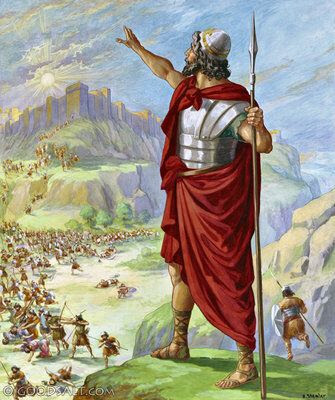
Probably one of the most famous moments in the Book of Joshua (and the Old Testament) is the destruction of Jericho. The king of Jericho is on high alert after expecting Israelite spies and closes his gates entirely, thus the walled city cannot be breached. Joshua commands a siege of the walled city to no effect. He is then visited by an angel who presents himself as a host of the Lord and instructs Joshua to remove his sandals. Just as it had happened to Moses, Joshua is now in the presence of the Lord, and lays prostrate to the ground to worship him. 

God then instructs Joshua to march around the city for six straight days. On the seventh day they were to march around the city seven times before the priests would blow their horns and the people would shout. At this point the walls miraculously collapsed and the Israelite army was easily able to sack the city. Upon the instructions of God, they left no survivors except for the harlot Rahab who had aided them in their breach. This marked the first major victory for the Israelites, however they did not settle here but pressed on with their campaign. 

The Battle of Ai

From this victory Joshua lead the Israelites westward into central Canaan to sack the city of Ai. However they had temporarily lost favor with God, due to an Israelite named Achan who disobeyed God's instructions not to pillage from the city of Jericho. Nonetheless Joshua liked his odds against the smaller army of Ai, and sent 3000 soldiers to assault the gates. However the soldiers of Ai were able to repel the attack and killed 30 Israelites forcing them to retreat. At this point Joshua prayed fervently to God asking for assistance. God explained to Joshua the sin that had been committed against him, and how the entire people were to be punished. To answer for this sin, Joshua ordered Achan and his family be stoned to death, which regained favor with the lord.

Joshua then led a 2nd assault on the city of Ai, with the full counsel and support of the Lord. God instructs Joshua to approach the front gates with a small force, while simultaneously arranging an ambush at the rear with a much greater force of 30,000 soldiers. The king of Ai sends his full force to face Joshua's smaller force at the front of the gates. Joshua pulls his army back while the Israelite army at the rear, easily penetrate and sack the city of Ai. Joshua then holds up a javelin by Gods command to lead the final assault on the Ai army, with flanking support from their rear position. The king of Ai is captured and hanged on a tree at the front of the gates. God permits that the Israelites can plunder the livestock but must leave no survivors and burn the city down just as they had done with Jericho. 

The Amorite Alliance

At Mount Ebal Joshua erects an altar to once again give glory and homage to God for their recent victories. By this point however the native Canaanite kingdoms (also known as Amorites) began to fear Joshua's invading army and decided to form an alliance against him. This Amorite alliance consists of the kingdoms of Jerusalem, Hebron, Jarmuth, Lachish, and Eglon. Meanwhile the Gibeonites (who were also a kingdom of Canaan) attempt to ally with Israel and welcome them to their city of Gibeon. However when Joshua discovers that they are Canaanites, he decides to enslave them for fear that they cannot be trusted.

King Adonizedek of Jerusalem leads the Amorite Alliance to attack the city of Gibeon, as punishment for siding with the Israelites. Joshua decides to save the city of Gibeon with counsel from the Lord. He marches his army from their post in Gilgal to face the 5 Amorite armies and easily causes them to retreat. He famously requests that God halt the sun, so that his army has more time to fight in the light. While the Amorites began to escape God hurls large hailstones down upon them causing great devastation. Meanwhile the 5 Amorite kings took shelter in a cave but were later discovered and executed by Joshua. Just as he did with the kings of Jericho and Ai, Joshua had the 5 Amorite kings hanged upon trees. This marked the Israeli conquest of southern Canaan and Joshua then turned his attention to the northern kingdoms.

The Northern Confederacy    

News of Joshua's victories reached the northern kingdoms of Canaan, most notably it's largest city of Hazor. King Jabin of Hazor established a northern alliance with the kingdoms of Shimron, Madon, Achshaph, and the remaining strongholds of Amorites, Hittites, Perizzites, and Jebusites. This was to be the final stand against the invading Israelite army of Joshua. The Northern coalition of Canaanite armies arrived at the site of Merom near the Sea of Galilee. Joshua met them with his entire Israelite army at the Battle of the Waters of Merom to bring an end to the Canaan military campaign.

With instructions from God, Joshua crippled the Canaanites' horses and burned their chariots overnight and then came upon them in surprise with his full force. It was once again a slaughter for the Israelites who sent the Canaanite armies fleeing in every direction. Joshua pressed his army onward to capture the capital city of Hazor, kill their king, and burn the city to the ground. They once again left no survivors however claimed all plunder from their victories. This marked an end to the Jewish exodus, Joshua's military campaign, the destruction of the native Canaanites, and God's ultimate covenant that the Israelites occupy this Promised Land (which they would later rename Judah and Israel).

Division of the Lands

Following their conquest of Canaan, God gave Joshua thorough instructions to divide the region among the 12 tribes of Jacob. The first 4 to receive their allotted land were Rueben, Gad, Judah, and Ephraim. This was the prime territory at the heart of Canaan which surrounded the Dead Sea and the Jordan River. The Tribe of Benjamin also claimed a central territory incorporating the Canaanite cities of Jericho, Gibeon, and Jerusalem. The remaining tribes of Simeon, Dan, Manasseh, Issachar, Zebulun, Naphtali, and Asher were allocated territory on the outskirts. These tribes would eventually unite into two kingdoms (Israel and Judah) under the leadership of Saul, David, and Solomon. 

In his final years Joshua is at peace having lead the fulfillment of God's promised land to the Israelites. In the land of Shechem he holds a grand assembly to give one final address to the chief leaders. He reminds them of their covenant with God and to always obey the Laws of Moses. He also emphasizes that they not make friends with the neighboring tribes, which could lead them away from their God. Joshua then laid out a large stone to represent the eye of God, which would bear witness to any transgressions against the lord. He then died at the age of 110 years old and was buried in Shechem.